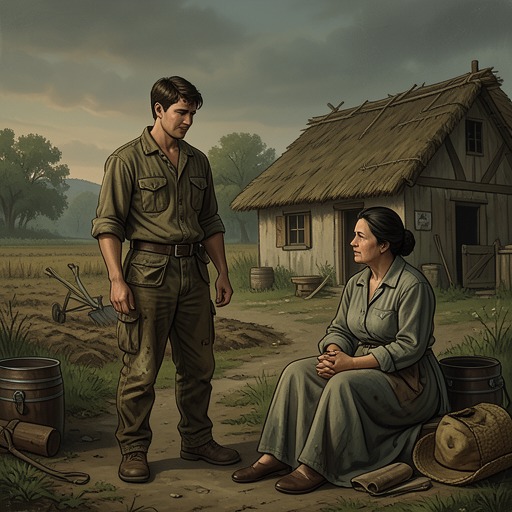
Nastka Gołębianka
The PeasantsNastka Gołębianka emerges in the village scenes as both a participant in youthful courtship and a devoted sister. The narrative gives her no extended personal history, but its recurring glimpses of her—dancing with Szymek Pacześ, visiting Mateusz the Young Villager, and appearing among the women preparing for church—trace a character whose social life is shaped by affection, family obligation, and the close attention of Lipce. Her importance lies in that combination: the apparent lightness of courtship is repeatedly set beside the material costs of caring for family.
Identity and Place in Lipce
Nastka is identified as Mateusz the Young Villager’s sister. The evidence places her among the young people at village gatherings and in the orbit of Dominikowa’s household, where Szymek, Dominikowa’s elder son, watches for her attention. She is not given a separate account of her family circumstances or private thoughts; instead, the novel builds her presence through witnessed interactions and village conversation. That indirect portrait makes her a figure within Lipce’s shared social world, where a dance, a visit, or a journey to the mill can become visible to neighbors and available for comment.
At one gathering, Nastka and Jagna move about together with their arms around each other’s waists, laughing and whispering. Szymek keeps watching Nastka and repeatedly approaches her with vodka, trying to get a word in. The scene sets her in the center of a lively social room, but also shows Szymek’s focused attention amid the crowd. Around them, the young people spill outside to romp in the yard, while elders call warnings from the windows. The festivities are communal, yet courtship takes shape through small, observable choices within them.
Courtship with Szymek
At another dance, Nastka and Szymek have arranged in advance to pair up. When the music starts, they dance exuberantly, then walk about with their arms around each other’s waists, laughing and talking as they catch their breath. Their ease together is sufficiently conspicuous that Dominikowa glances anxiously at her son. The sequence presents their attachment not as a private declaration but as a public pattern of chosen proximity: they seek one another out, move together, and make their pleasure visible.
Village gossip gives that closeness a wider frame. Women remark that Szymek is trailing after Nastka and compare the younger generation’s behavior with that of their parents, invoking the saying that the apple does not fall far from the tree. The comments turn courtship into a subject of communal interpretation, linking individual conduct to family reputation. Elsewhere, Szymek comes to Dominikowa’s home early in the evening, ostensibly to visit but chiefly to meet Nastka; the two sit side by side and speak quietly. Across the dance floor and the chamber, their courtship shifts between public exuberance and a quieter, deliberately sought meeting.
Loyalty to Mateusz
Nastka’s relationship with Mateusz the Young Villager is shown through care at a point when he is badly injured. When Hanka the Farmstead Keeper encounters her on a cold night, Nastka says she is going to the mill. Hanka explains that she is taking supper to Mateusz, who is working at the adjacent sawmill; Nastka asks whether he is learning to be a miller, and Hanka clarifies that he is working at the sawmill instead. The exchange places Nastka in the same network of concern around her brother, while distinguishing her errand from Hanka’s: it is Hanka, not Nastka, who says she is carrying the supper.
Nastka later tells Jagna that Antek the Lover has beaten Mateusz. She recounts that Antek seized him by the collar, carried him out of the mill, and threw him against a fence; Mateusz fell into the water and nearly drowned. She reports that four ribs were broken, that he is spitting blood and unable to move, and that he continues to groan in pain. As she tells the story, Nastka bursts into tears. Her account is both a transmission of news that had not reached the Boryna household and an emotional response to her brother’s suffering. Jagna immediately understands that the attack was connected to her, but Nastka’s distress keeps the focus on the bodily harm Mateusz has endured.
Family Care and Narrative Role
Nastka’s concern continues beyond the first report of the assault. She visits Mateusz, who is confined by illness, and village talk represents her effort as costly: she is said to be selling her last woollen skirt to make an Easter for him. The report comes in a conversation that also notes her growing friendship with Jagna and her visits to Dominikowa’s household. These details connect her family loyalty to the ordinary movements of village life—visiting, keeping company, and preparing for a religious feast—while making clear that such care takes place under conditions of limited means.
Her appearances in church-related scenes extend this picture without turning her into a public spokesperson. She arrives dressed for church with palms in hand when Hanka promises to return something there; Hanka then asks whether she has news of Mateusz, and Nastka can offer only the report that he is better. The brief exchange makes his recovery a continuing concern, not a matter settled by the earlier account of his injuries.
The narrative’s portrait of Nastka therefore rests on recurring contrasts: animated dancing and quiet visits, village gossip and private concern, courtship with Szymek and loyalty to Mateusz. She is shown less through self-explanation than through what she does and what others notice—whom she chooses to dance with, whom she visits, and what she is prepared to give up for her brother. Those episodes make her relationships the clearest measure of her character, while also showing how affection in Lipce is lived in public view and tested by poverty and injury.